
Undertaught: free life-skills lessons, each one sourced
A free, sourced life-skills school on the web: 150 lessons in nine areas, a two-minute test, and a checking process that's written down on the site.
- Kind
- Our own product
- Launched
- Services
- Design
- Build
- Writing
- Search setup
- Hosting
- Built with
- Next.js on Vercel
- Lessons stored as structured content files
- Vercel Blob for anonymous test results
- Automated tests at desktop and phone widths
- Scheduled source and link checks
- Visit site
- undertaught.com (opens in a new tab) ↗
Results so far
- 150Free step-by-step lessons liveUndertaught, The Manual page,
- 282Cited claims checked against their sourcesUndertaught source audit,
- 22Claims corrected in that auditUndertaught source audit,
What it is
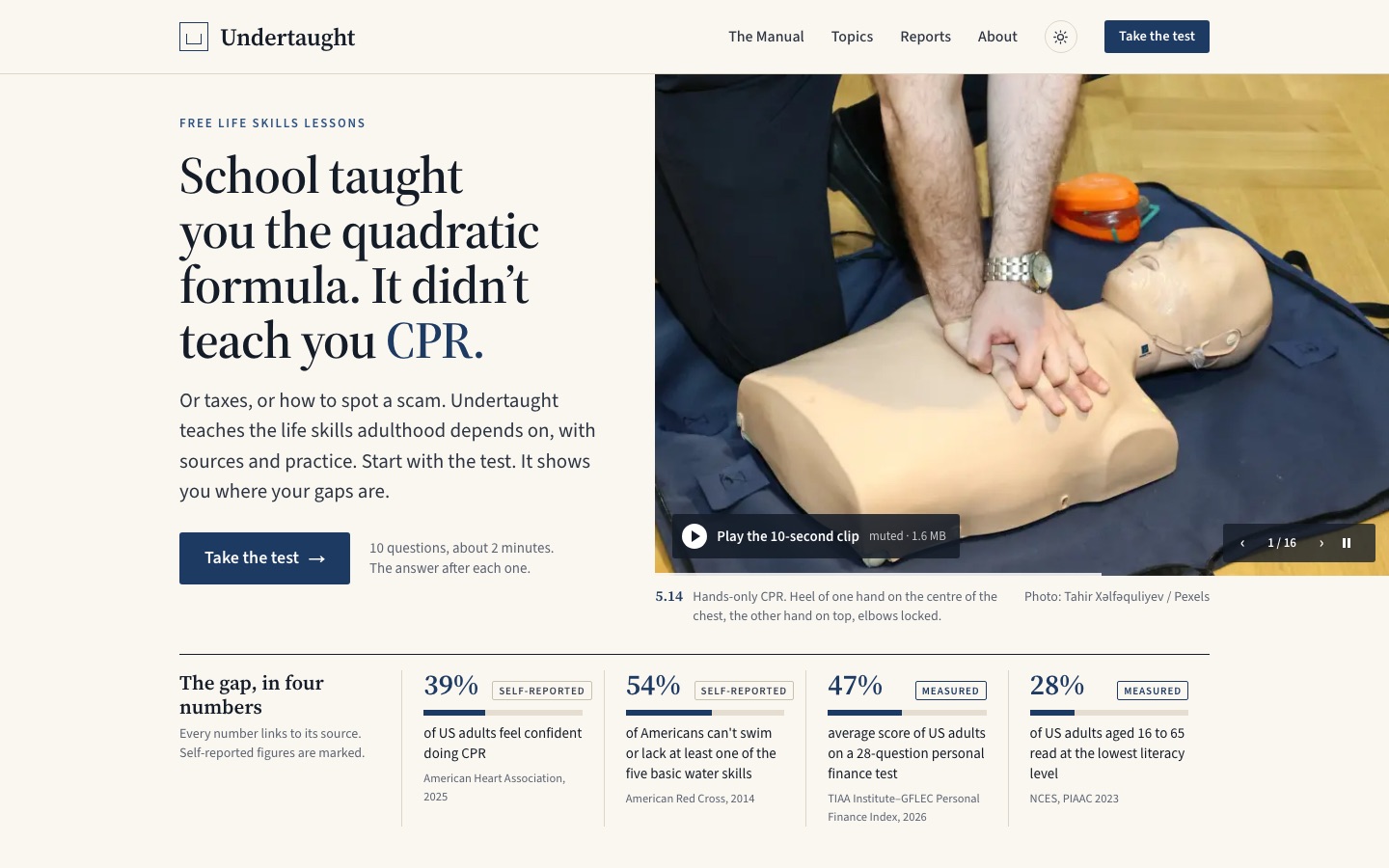
Undertaught is a free website that teaches the practical skills school tends to skip: hands-only CPR, cooking chicken to a safe temperature, spotting a scam text, writing a cheque, changing a flat tire. It’s our own product. We designed it, built it and run it, and nobody commissioned it.
The heart of the site is The Manual, with 150 step-by-step lessons in nine areas: Body, Mind, People, Money, Safety, Information, Kitchen, Home and Hands. Around it sit a 10-question test, a curriculum arranged by age, topic pages, and longer reports and guides.
Who it’s for
Undertaught is written for adults and teenagers in Canada and the United States. Where the two countries differ, as they do with taxes and retirement accounts, lessons give both, so a reader sees the CRA and the RRSP beside the IRS and the 401(k). Emergency lessons send people to a certified class where one exists, because reading about CPR isn’t the same as practising it.
What we built
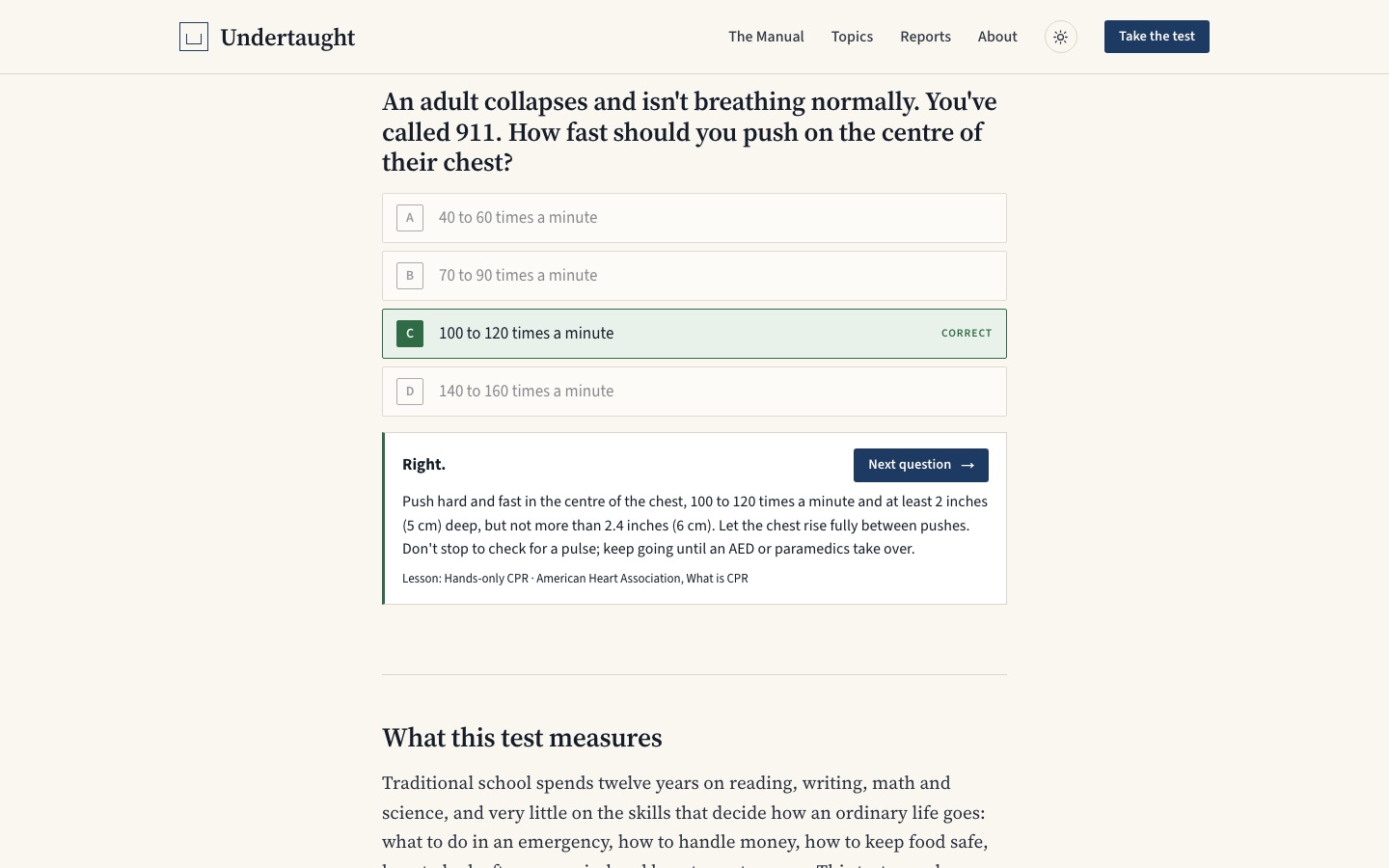
The test is the front door. It asks 10 multiple-choice questions that cover all nine areas, and it takes about two minutes. After each answer it shows the right one, a short explanation, and links to the lesson and the source. You don’t need an account to take it.
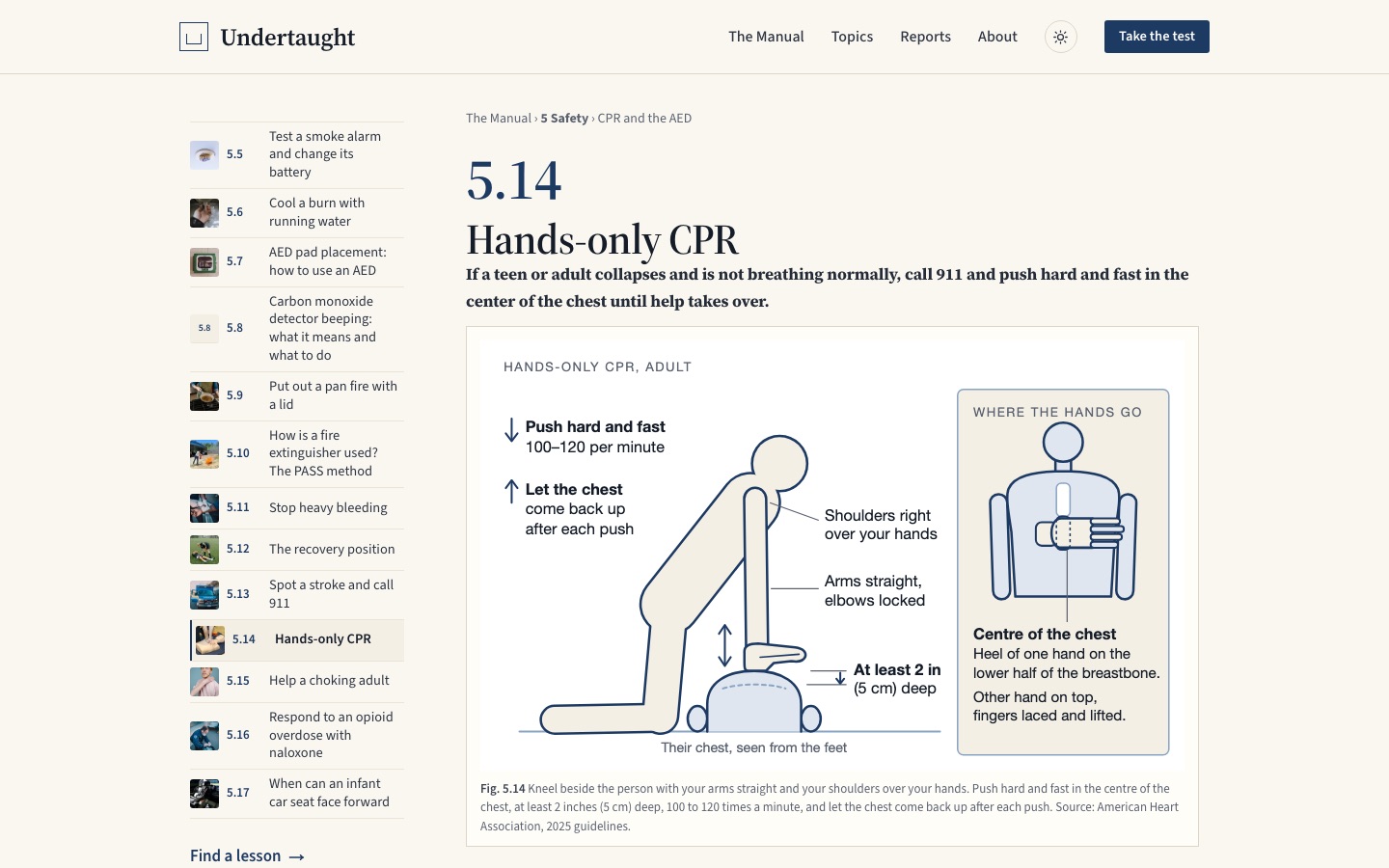
Every lesson follows the same plan. It opens with a one-line rule, then explains why it matters, how to do it, the common mistakes and the sources. Some lessons, like hands-only CPR, open with a diagram drawn for that lesson. On a wide screen, a side column lists the other lessons in the same area so people can keep going.
The home page leads with four numbers about the gap in these skills. Each one links to its source and is labelled either self-reported or measured, because what people say about themselves is often more flattering than what a test finds.
How the lessons are written and checked is printed on the About page, and we follow it for every lesson:
- 1
Draft
Each lesson, guide and report is drafted with AI tools. Every number has to come from a primary source: a government agency, a statistics office, a published survey or a peer-reviewed paper.
- 2
Check against the source
A separate review matches every number to the passage in the source that states it. Claims the source doesn't support are cut.
- 3
Label and cite
Self-reported figures are marked as such, and every source is cited where its number appears.
- 4
Re-check on a schedule
Every source link and cited number is checked again on a schedule, and the date of the last full check is printed under each lesson's sources.
How it’s built
Undertaught runs on Next.js and is hosted on Vercel. The lessons, areas, stages and test questions live in structured content files, so adding a lesson updates The Manual, its area page, the sitemap and the feed in one step.
Test results are stored anonymously in Vercel Blob storage and tallied by a nightly job. Automated tests run the main pages at desktop and phone widths, along with accessibility checks, before changes go live. A link checker re-tests the cited sources every month, which matters on a site where every claim points somewhere else.
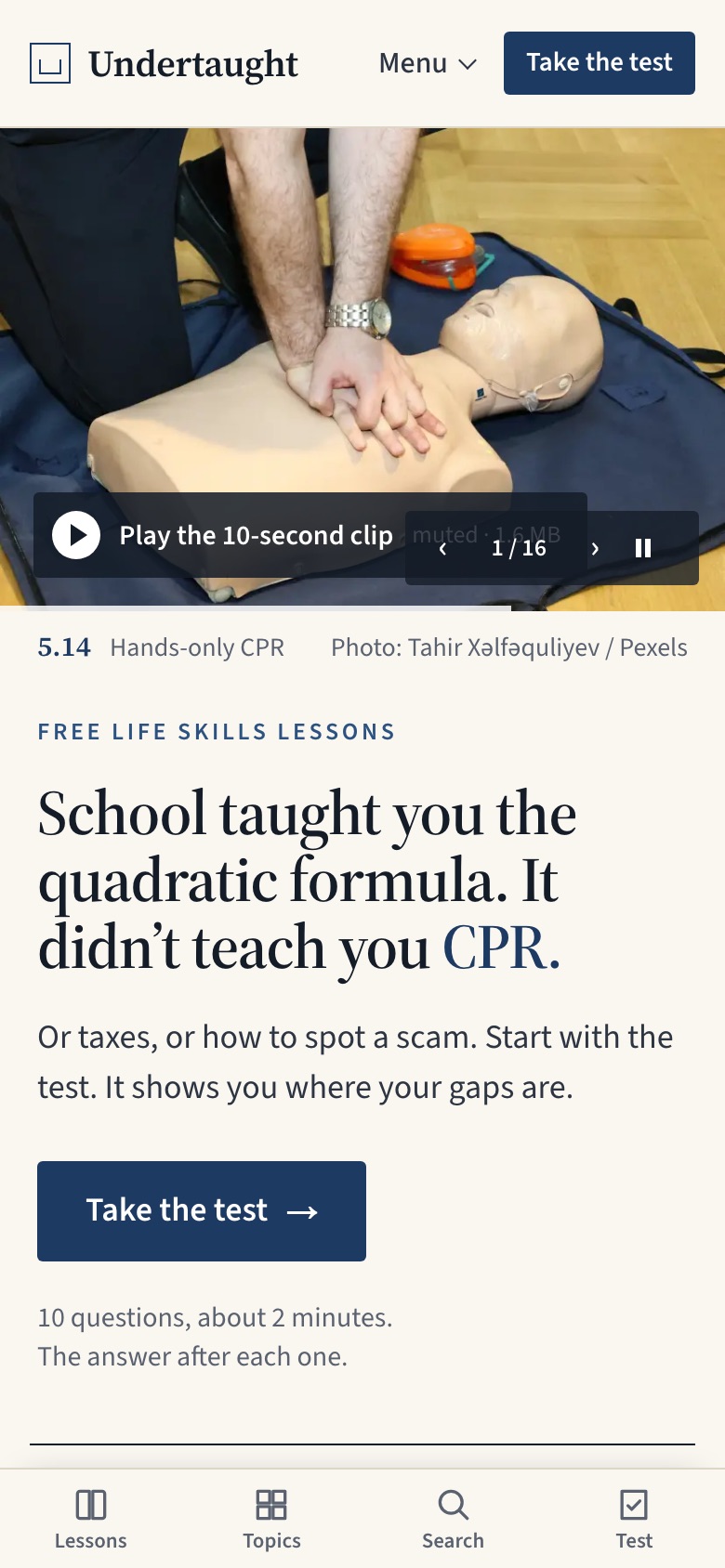
The site has light, night and dark themes, and on phones a bottom bar keeps Lessons, Topics, Search and the Test one tap away.
What happened since launch
Undertaught went live on October 22, 2026 with 140 lessons, and a batch of 10 more went up the next day, bringing it to 150. Three days after launch we found it too hard to get around on a phone: the phone header had the logo, one link and a button, and The Manual was one very long page. We added a phone menu, the bottom bar, a lesson finder and a page for each of the nine areas. It’s too early for search numbers we’d want to quote.
What this means for your site
Two things carry over to a small business site. The first is showing your sources and dates. If your page says a furnace tune-up costs a certain amount, or that you’re licensed and insured, say where that comes from and when you last checked it. People trust what they can verify.
The second is testing on a real phone and fixing what you find. Most people who visit a local business site are on their phone, and a site that’s hard to navigate there loses them. We test every page we build at phone width before it goes live, and we keep fixing what we find after launch, the same way we did here. Our guide to how long it takes to build a website explains where that testing fits in a project.